
Which jobs you can actually do yourself
Not every maintenance item on your vehicle requires a lift, a diagnostic scanner, or a certified technician. Several tasks that shops charge labor rates for are genuinely accessible to a family with basic tools, a clean driveway, and a few minutes to read the owner's manual first. The goal here is not to turn you into a mechanic. It is to help you spend money at the shop on the jobs that actually need to be there, and handle the rest yourself.
The tasks below are selected because they involve no work under a raised vehicle, no high-pressure fluids, no high-voltage systems, and no specialized tools beyond what most hardware stores carry. Each one can be confirmed against your vehicle's owner's manual before you start.
Engine air filter replacement
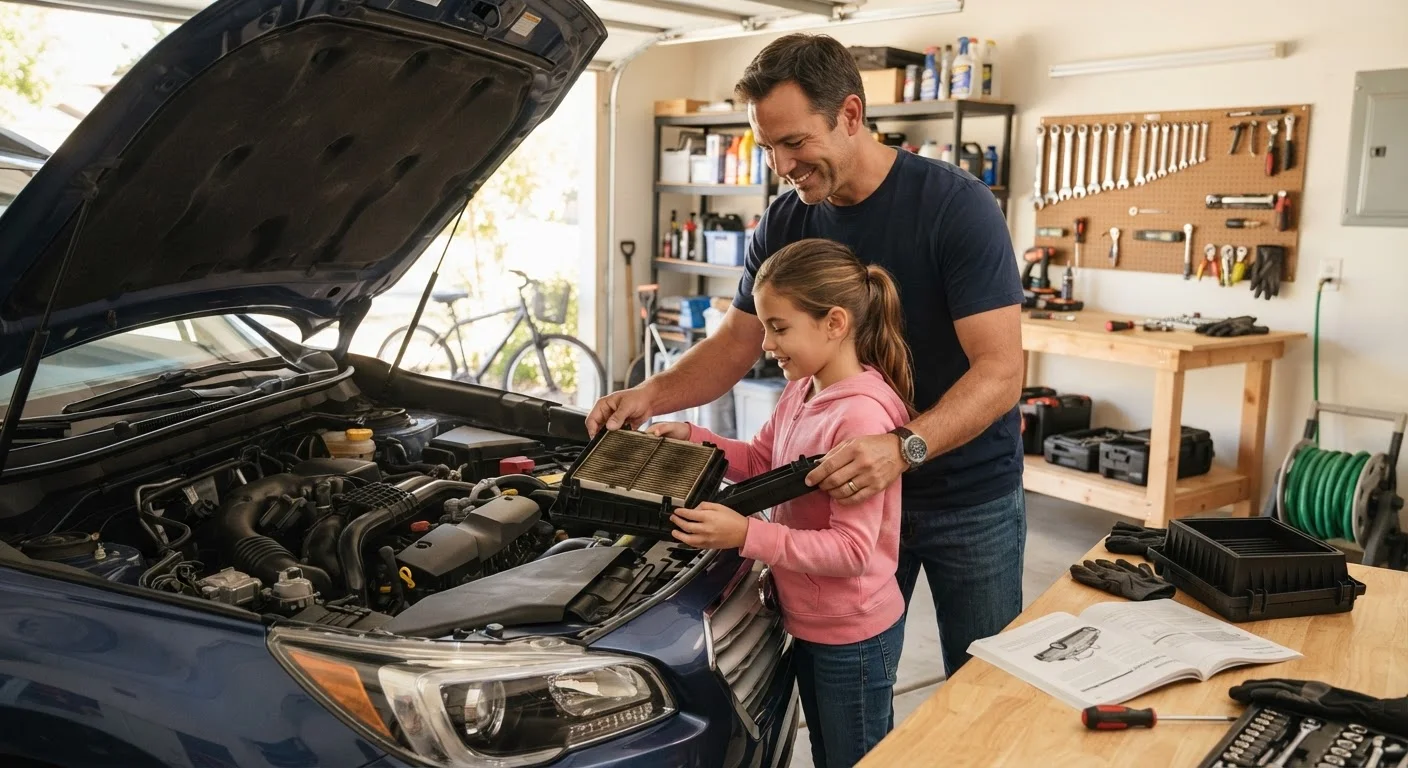
The engine air filter prevents dust and debris from entering the engine. Most manufacturers recommend inspecting it every 15,000 to 30,000 miles, though driving on unpaved roads shortens that interval. On the majority of passenger vehicles, the filter sits inside a plastic housing in the engine bay that unclips or unscrews without tools.
The replacement takes under 10 minutes. Check your owner's manual for the correct filter specification, compare the old filter visually to the new one before installing, and confirm the housing lid is fully secured when you finish. A clogged filter can reduce fuel economy, so this is a task with a direct cost payoff.
A clogged engine air filter can reduce fuel economy, making this swap one of the most cost-direct tasks you can do.
Cabin air filter replacement
The cabin air filter cleans the air that flows through your heating and air conditioning vents. It is typically located behind the glove box or under the dashboard, and accessing it usually requires removing a panel that clips in and out without tools. Some vehicles route it under the hood near the base of the windshield.
Manufacturers generally suggest replacing it every 15,000 to 25,000 miles. A dirty cabin filter reduces airflow from your vents and can affect HVAC system efficiency. Shops often charge substantial labor on this replacement despite the job taking roughly 15 minutes once you have located the filter with your owner's manual.
Shops often charge significant labor for a cabin filter swap that takes about 15 minutes at home.
Windshield wiper blade replacement
Wiper blades degrade from UV exposure and temperature swings, and most need replacement every six to twelve months in climates with harsh winters or intense summer sun. Reduced smearing, streaking, or squeaking are reliable signs it is time.
Most wiper arms use a hook-style connector that releases with a small tab. The packaging for replacement blades typically includes instructions for each common connector type. Matching the blade length to your vehicle matters, and your owner's manual or the auto parts store's reference guide will have that information. The physical swap takes less than five minutes per blade.
Wiper blades take under five minutes to replace and should be changed every six to twelve months in most climates.
Checking and topping off fluid levels
Engine coolant, windshield washer fluid, power steering fluid (on vehicles that use it), and brake fluid all have reservoir caps that are accessible from above the engine bay. Checking levels is a visual inspection requiring no tools. Topping off windshield washer fluid is straightforward. The others require more caution.
Never open the coolant reservoir cap when the engine is hot. Use only the fluid type specified in your owner's manual, since using the wrong coolant or brake fluid formulation can cause damage. If your brake fluid level is consistently low, that signals a potential leak and calls for a shop inspection rather than simply adding more fluid.
A low brake fluid level that keeps dropping is a sign of a leak, not just a top-off situation.
Tire pressure checks
Tire pressure affects fuel economy, handling, and tire longevity. The correct pressure for your vehicle is listed on a sticker inside the driver's door jamb, not on the sidewall of the tire. A basic tire pressure gauge costs a few dollars and takes about two minutes to use per tire.
Tires lose roughly one pound per square inch (PSI) of pressure for every 10-degree drop in ambient temperature, so pressure checks are especially worthwhile at the start of cold weather. Many gas stations have air pumps, and some provide them at no charge. Checking pressure monthly or before long trips is a habit that costs almost nothing and protects your tire investment.
Tire pressure drops roughly 1 PSI for every 10-degree temperature drop, making fall checks especially worthwhile.
Battery terminal cleaning
Corrosion on battery terminals, the white or bluish buildup around the cable connections, increases electrical resistance and can lead to starting problems. Cleaning terminals requires only a wrench to loosen the cable clamps, a wire brush or an old toothbrush, and a baking soda and water mixture to neutralize the corrosion.
Always disconnect the negative cable first and reconnect it last. Wear gloves and avoid touching your eyes during the process. If the terminals themselves are heavily corroded, cracked, or the battery case is bulging, have a shop evaluate the battery before cleaning it. This task is not appropriate if the battery shows signs of damage or leaking.
Corroded terminals add electrical resistance and can cause intermittent starting problems that are easy to prevent.
A note on knowing your limits
The list above covers jobs with low physical risk and low consequence for a first-time mistake. Brake service, suspension work, fuel system repairs, and anything involving the airbag system belong at a qualified shop, full stop. Saving $40 on a cabin air filter is worthwhile; attempting a brake caliper swap without the right knowledge is not a trade-off worth making.
The same logic that applies to household budgeting applies here. Just as you would audit which grocery expenses are fixed versus flexible (see the smart grocery shopping routine for a comparable framework), it helps to sort your vehicle's maintenance list into what you can absorb at home and what genuinely needs professional hands.
Keep a simple maintenance log
A basic notebook or a notes app on your phone works fine. Record the date, mileage, and what you did for each task. When you take the vehicle to a shop, that log helps the technician understand what has already been done and avoids duplicate charges. It also makes it easier to see when the next filter or wiper replacement is due.
Track what you spend on DIY maintenance versus shop visits each year. Over 12 to 24 months, that record shows you clearly where your money is going and whether the at-home tasks are actually saving you what you expect.