What the sticker is and why it exists
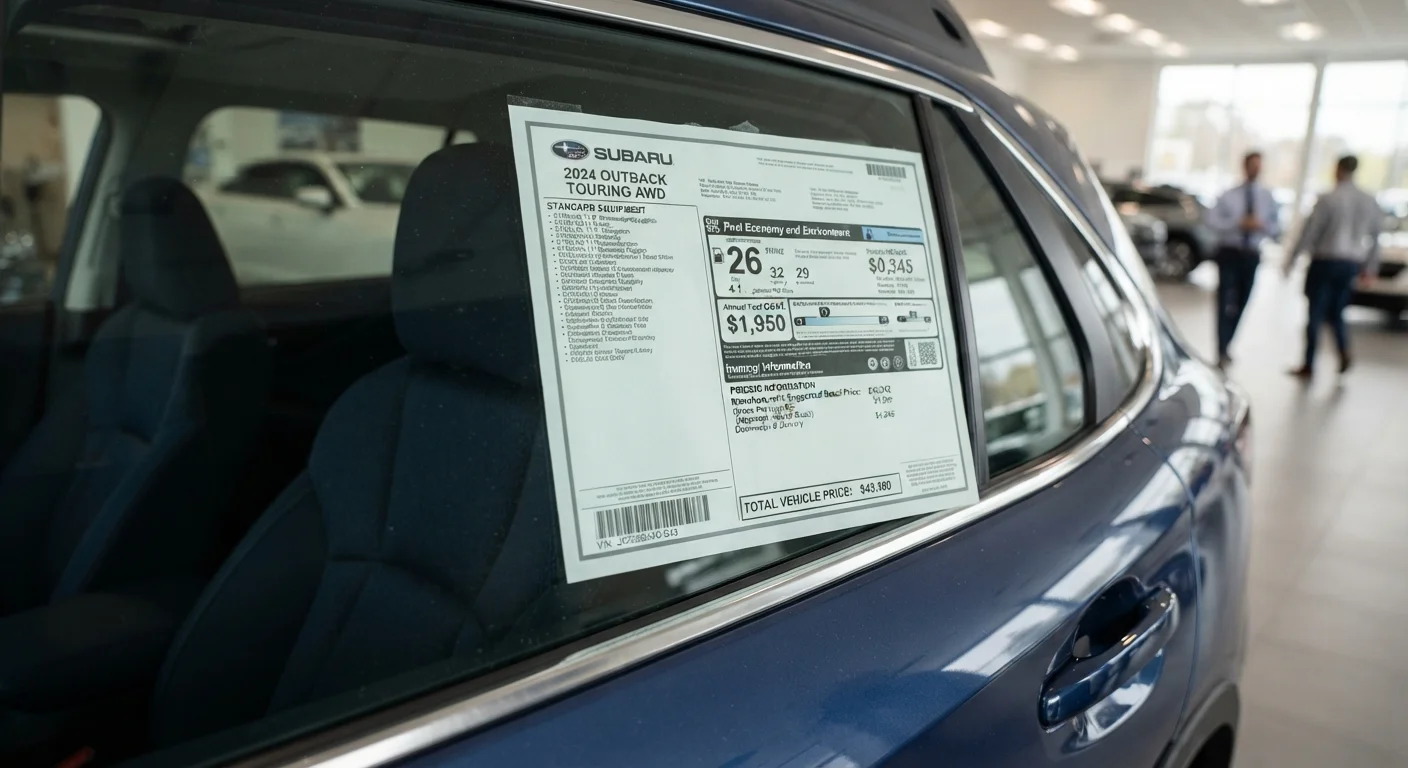
Before a shopper asks a single question on a dealership lot, the window sticker has already answered several important ones. The Automobile Information Disclosure Act of 1958 requires every new passenger vehicle to carry a Monroney label listing the base price, installed options with individual costs, destination and delivery charges, and EPA fuel economy ratings. The law exists specifically so buyers can compare vehicles without relying solely on a salesperson's description.
For families focused on long-term affordability, the sticker is a financial document, not a marketing one. Each line on it connects to a real cost you will pay, either at signing or over years of ownership.
Breaking down the price section
The sticker separates the base price from the cost of individual option packages. That separation matters. A vehicle with a $32,000 base price and $6,000 in added packages is not the same financial proposition as a $38,000 base-trim model, even if both have identical sticker totals. Option packages frequently include features you may not need, and they rarely return their full cost at resale.
Destination and delivery charges are also listed here. These are set by the manufacturer and are generally non-negotiable, unlike the vehicle price itself. Knowing that figure prevents confusion when you receive a dealer's out-the-door quote.
Check the out-the-door price, not just the sticker
Always ask the dealer for a complete out-the-door price in writing before comparing offers. This figure includes taxes, registration fees, documentation fees, and any dealer add-ons. The Monroney sticker total does not include these, so using it alone as your comparison point will understate the true purchase cost.
The sticker price is only part of the picture. For a full accounting of what a vehicle costs a family each year, see the recurring costs that accumulate after purchase.
Fuel economy estimates and what they predict
The EPA fuel economy section is where many families leave money on the table by skimming past the numbers. The sticker shows city, highway, and combined MPG figures, plus an estimated annual fuel cost calculated at a standardized mileage and fuel price. That cost estimate allows direct, apples-to-apples comparison across different vehicles on the same lot.
A difference of five MPG between two otherwise similar vehicles can add up to several hundred dollars per year in fuel spending, depending on gas prices and how much you drive. Over a five-year ownership period, that gap is meaningful for a household budget. The sticker also shows a range of annual fuel cost to account for higher and lower fuel price scenarios, which gives a more realistic picture than a single figure.
5 MPG
Fuel economy gap that shifts annual costs noticeably
The EPA's cost comparison tool shows that a 5 MPG difference at 15,000 miles per year and $3.50 per gallon adds roughly $200 to $350 in annual fuel spending, depending on the vehicle class.
$1,200+
Typical range of dealer supplemental sticker add-ons
Consumer advocacy organizations have documented that dealer-added accessories and market adjustments on supplemental stickers routinely exceed $1,000 on popular models in high-demand periods.
1958
Year the Monroney disclosure law took effect
The Automobile Information Disclosure Act was signed into law in 1958, making the window sticker a federally required document on every new passenger vehicle sold in the United States.
Safety ratings and their financial consequences
The Monroney label includes the vehicle's National Highway Traffic Safety Administration (NHTSA) overall star rating, with a QR code or web reference directing buyers to the full results. A five-star NHTSA rating and a top safety pick designation from the Insurance Institute for Highway Safety (IIHS) are not just safety credentials. They influence what you pay for auto insurance.
Insurers price collision and comprehensive coverage partly on how well a vehicle protects occupants and how much damage it sustains in crashes. A vehicle with poor crash performance typically costs more to insure than a structurally similar one with strong ratings. For more on what drives those differences, see why insurance premiums vary between vehicles.
The supplemental dealer sticker
Many dealerships attach a second sticker, separate from the Monroney label, listing additional charges. These may include market adjustments (a markup above MSRP, common when a model is in short supply), dealer-installed accessories such as paint sealant or fabric protection, and advertising fees. None of these are federally mandated or standardized.
Unlike the manufacturer's destination charge, items on a dealer sticker are negotiable. A paint protection coating priced at $800 on the sticker might cost a fraction of that if applied independently. Identifying which charges originate with the manufacturer and which originate with the dealer is the first step toward reducing them. The Monroney label itself never contains dealer markups, so anything beyond that document's total is dealer-generated and worth scrutinizing.