
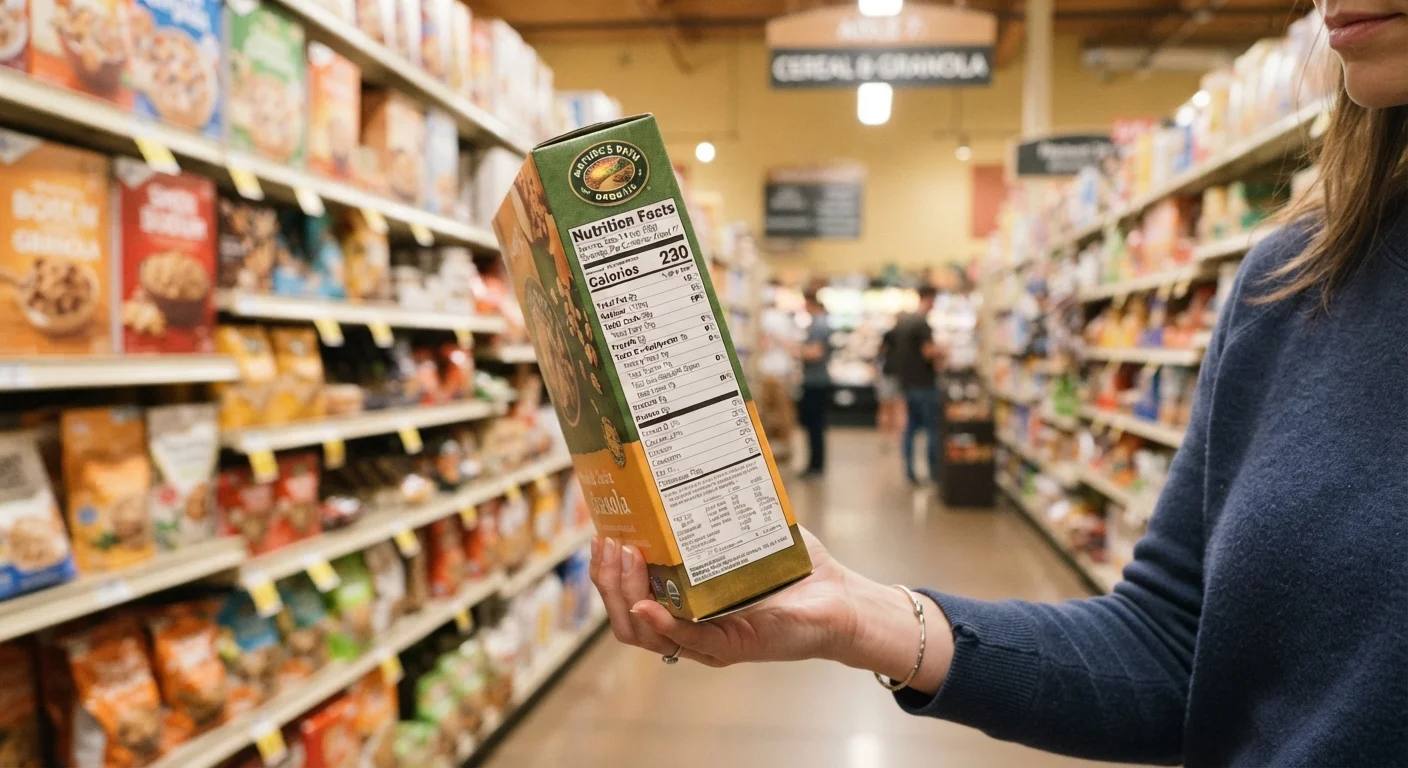
Why nutrition labels matter for everyday food choices
The Nutrition Facts panel is required by the U.S. Food and Drug Administration on most packaged foods. It is a standardized tool that lets you compare products using the same format, regardless of brand or package size. Families who understand how to use it can make more informed choices at the grocery store without spending more money.
Food marketing on the front of a package, words like "natural," "wholesome," or "light," is not regulated the same way the Nutrition Facts panel is. The panel on the back or side is where the verified numbers are. Getting comfortable with it takes only a few shopping trips of deliberate practice.
For broader context on building a practical grocery routine, see our guide to meal planning from scratch, which covers how to approach weekly food decisions as a family.
How to read the panel section by section
Work through the label in this order to get the most useful information quickly.
Check the serving size first
Every number on the label, calories, fats, sodium, vitamins, is based on one serving. The serving size is listed at the very top of the panel in common household measures (for example, "2 cookies" or "1 cup") alongside the gram weight. If you eat two servings, every number doubles. The panel also shows "servings per container" so you can quickly calculate what the entire package contains.
Read the calorie count in context
Calories measure the energy a food provides per serving. The number alone does not tell you whether a food is nutritious, but it gives context when combined with the rest of the label. A food high in calories alongside meaningful amounts of fiber, protein, or vitamins is different from one that is high in calories with little else to offer.
Use the % Daily Value column as a quick guide
The % Daily Value (%DV) column on the right side of the panel tells you how much of a nutrient one serving contributes toward a general daily target, based on a 2,000-calorie reference diet. The FDA's rule of thumb: 5% DV or less is considered low for a nutrient, and 20% DV or more is considered high. Use this column to quickly identify products that are high in saturated fat, sodium, or added sugars, or to find options higher in fiber, calcium, or iron.
Scan the nutrients to limit
The panel groups certain nutrients under the category that most Americans consume in excess: saturated fat, sodium, and added sugars. These are listed toward the upper-middle section of the panel. Dietary guidelines from the U.S. Department of Agriculture and the Department of Health and Human Services recommend keeping these low relative to your overall daily intake.
Look for nutrients to get enough of
Toward the bottom of the panel, you will find fiber, vitamin D, calcium, iron, and potassium, nutrients that Americans commonly under-consume according to federal dietary guidance. Foods with higher %DV for these nutrients can help fill common gaps. Fiber is worth particular attention because it supports digestive health and tends to appear in whole or minimally processed foods.
Read the ingredients list
The ingredients list is separate from the Nutrition Facts panel but appears on the same package. Ingredients are listed in descending order by weight, so the first ingredient makes up the largest portion of the product. A short list with recognizable items generally indicates a less processed food. The ingredients list is also where you find all the names used for added sugars and where allergen disclosures appear.
Once you can move through these steps in under a minute, label-reading becomes a background habit rather than a chore. The same logic that applies to human food labels also surfaces in other consumer contexts. If you have ever wondered how to parse a dense information sheet on a product, our guide to reading electronics spec sheets walks through a parallel process for technical documents.
Spotting hidden sugars and excess sodium
Sugar appears under many names in the ingredients list: high-fructose corn syrup, dextrose, maltose, cane juice, fruit juice concentrate, and more than 60 other terms. The FDA now requires a separate "Added Sugars" line beneath "Total Sugars" on the Nutrition Facts panel, which makes it easier to see how much sugar was put in during processing rather than occurring naturally in the food.
Sodium is another nutrient worth watching. The Dietary Guidelines for Americans recommends adults limit sodium to 2,300 milligrams per day, and many packaged foods, especially soups, sauces, and snack items, carry a large share of that in a single serving. Because sodium increases palatability, it appears in foods that do not taste noticeably salty.
A faster way to compare sodium across products
When comparing two products, look only at the %DV for sodium rather than the milligram number. A product at 15% DV per serving is meaningfully higher than one at 6% DV, and the comparison takes about three seconds. This works for any nutrient you are tracking.
A practical approach is to check sodium and added sugars on any product you buy regularly, since those are the items that add up across a week of meals. Occasional foods with higher numbers are less consequential than everyday staples with them.
Teaching children and teenagers to use labels
Children who learn label-reading early build a concrete, portable skill. A straightforward way to introduce it is to turn a grocery trip into a comparison exercise: pick two versions of the same food and read the serving sizes and one or two nutrients together. Keep the focus on observation rather than judgment about food choices.
Teenagers can engage with the ingredients list more directly. Ask them to count how many names for sugar appear in a given product, or to find which ingredient is listed first. This connects label-reading to the broader idea that ingredient order reflects quantity, which is a fact grounded in FDA labeling regulations.
Building these habits pairs well with learning how to stretch a grocery budget. Our explainer on unit pricing covers the shelf tag numbers that show cost per ounce or per unit, which work alongside nutrition labels to support informed decisions.
This article is for general informational purposes only and does not constitute medical or dietary advice. Consult a registered dietitian or qualified healthcare professional for guidance tailored to your family's specific health needs.