Why pantry staples matter more than weekly specials
Weekly store sales get a lot of attention, but the steadiest savings in any household grocery budget come from what is already on the shelf. A pantry stocked with a core set of affordable, shelf-stable ingredients means fewer emergency trips, less food waste, and a reliable base for meals even when the fridge is sparse. For a deeper look at how shopping habits quietly inflate weekly spending, see why your grocery run costs more than it should.
The staples below are not a trendy shopping list. They are the ingredients that home cooks across income levels consistently reach for because they are cheap per serving, adaptable across many cuisines, and nutritionally solid. None of them require a specialty store or a bulk-club membership to find.
Check unit prices, not package prices
The sticker price on a bag or can tells you little about value. The cost per ounce or per serving is what matters when comparing sizes or store brands. Many grocery shelves display unit prices on the shelf tag. If yours does not, a quick calculation on your phone takes seconds and often reveals that mid-size packages beat both the smallest and the largest options.
The staples that do the most work
Dried lentils
Lentils are among the cheapest sources of protein and fiber available in any American grocery store. A one-pound bag typically yields eight or more servings and costs less than most single-serving snack items. Unlike dried beans, lentils require no soaking, which makes them practical on weeknights. They absorb the flavors of whatever they are cooked in, whether that is a spiced tomato broth, a mild coconut curry, or a simple vegetable soup.
The USDA Economic Research Service has consistently identified legumes as one of the lowest-cost protein sources per 100 grams compared to meat and dairy alternatives. Green, red, and brown varieties all behave differently when cooked: red lentils break down into a creamy texture suited to soups and dals, while green and brown lentils hold their shape for salads and side dishes.
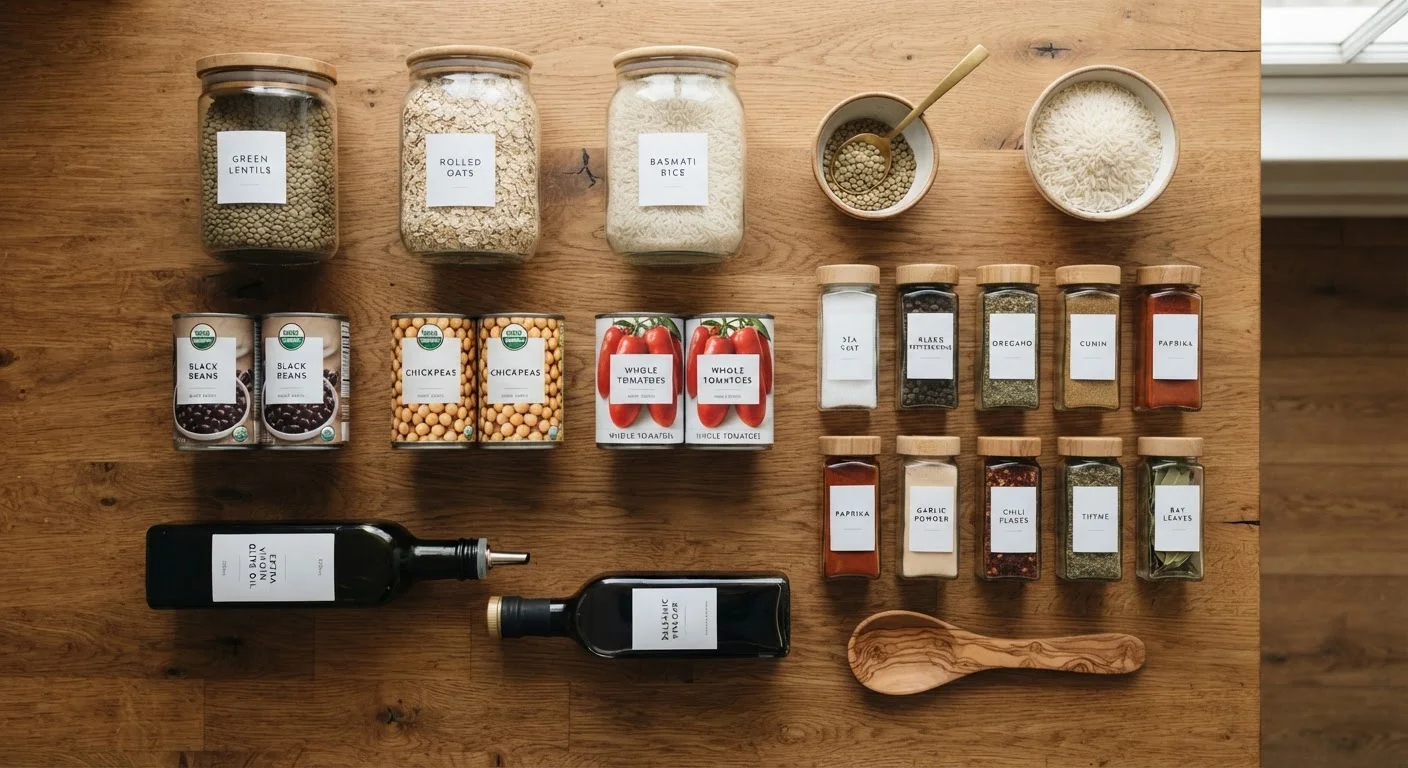
Lentils require no soaking and cost less per serving than almost any other protein source.
Canned tomatoes
A can of whole, crushed, or diced tomatoes is one of the most transformative ingredients in a budget kitchen. It forms the base of pasta sauces, braises, soups, stews, and shakshuka. Because tomatoes are canned at peak ripeness, the flavor is often more concentrated than off-season fresh tomatoes, and the price is significantly lower year-round.
Canned tomatoes pair with almost every protein and grain on this list, which makes them a genuine force multiplier for pantry cooking. A family that keeps six to eight cans on hand at any time can build a week of dinners around them without repeating a dish. For a fuller comparison of fresh versus canned produce costs and nutrition, see fresh, frozen, or canned produce.
Canned tomatoes are a flavor base for dozens of different dishes at a fraction of fresh tomato prices.
Brown rice and rolled oats
These two grains cover two meals of the day at very low cost. Brown rice is a complete starch base for dinner: it pairs with beans, lentils, stir-fried vegetables, and braised meats. A five-pound bag stretches over many meals and stores well for months in a sealed container. Rolled oats handle breakfast with the same economy. A canister of old-fashioned oats costs roughly the same as a single box of name-brand cereal but contains several times as many servings.
Both grains are shelf-stable for a long time when stored in airtight containers away from heat and moisture, which reduces the risk of food waste. Buying larger quantities when prices are stable lowers the per-serving cost further, a principle worth understanding through how unit pricing works at the grocery store.
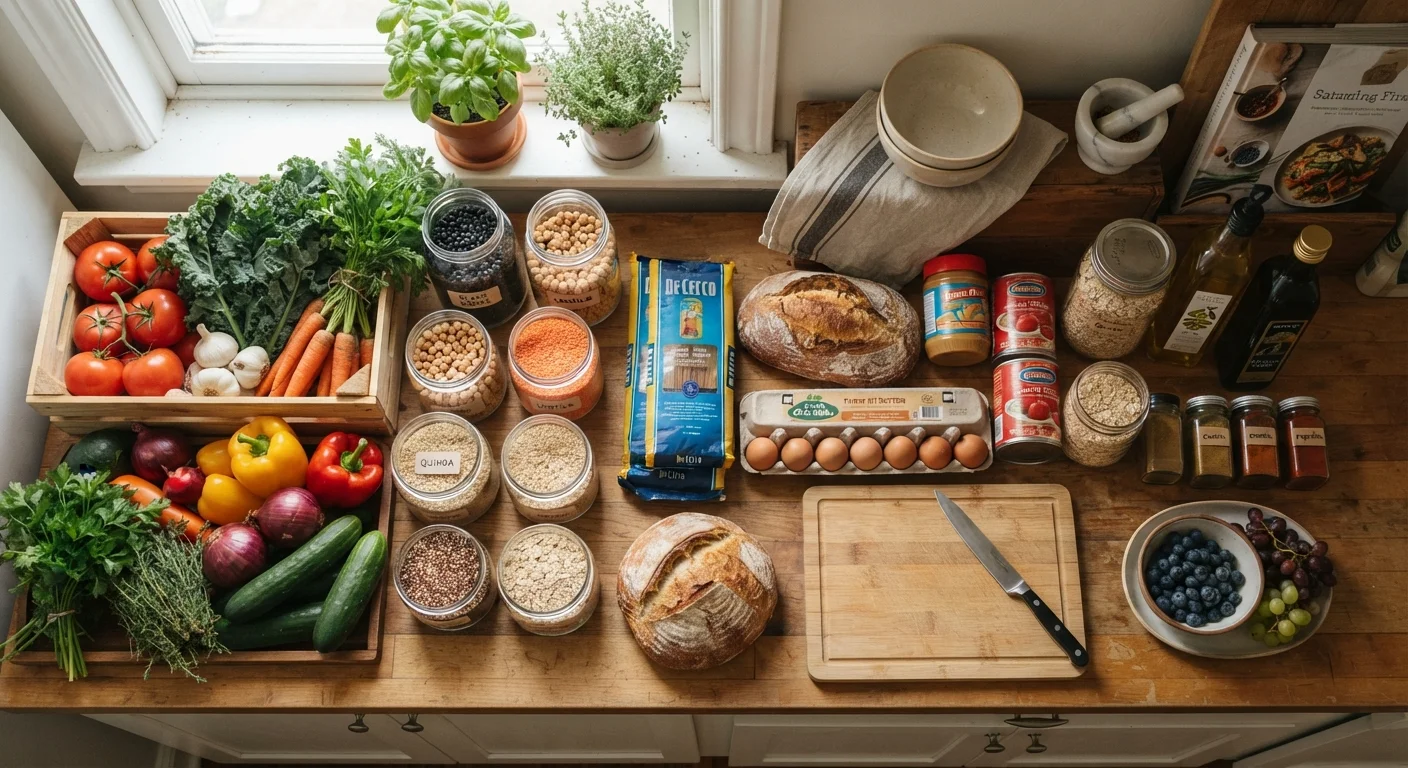
Brown rice and rolled oats together cover two daily meals at some of the lowest per-serving costs available.
Canned beans
While dried beans offer the absolute lowest cost per serving, canned beans trade a small price premium for genuine convenience. A can of chickpeas, black beans, or kidney beans is already cooked, requires no planning ahead, and opens up a full meal in under fifteen minutes. For families who find dried beans impractical on busy evenings, canned beans bridge the gap without abandoning budget-consciousness.
Chickpeas alone are unusually versatile: they work in Mediterranean-style salads, curries, roasted as a snack, and blended into hummus. Black beans anchor a fast taco night or a rice bowl. Keeping two or three varieties on hand means a protein source is always available regardless of what else is in the kitchen.
Canned beans deliver a cooked protein source in under fifteen minutes with no advance planning.
Onions, garlic, and basic dried spices
No list of budget staples is complete without aromatics. Onions and garlic are sold in bulk bags at low per-unit cost and store well at room temperature for weeks. They form the flavor foundation of soups, stews, stir-fries, and braises across virtually every cuisine. Without them, even a well-stocked pantry produces flat, monotonous meals.
A small set of dried spices, such as cumin, paprika, coriander, turmeric, and chili flakes, multiplies the range of dishes possible from the same core ingredients. The same pot of lentils tastes distinctly different seasoned for a Moroccan-style soup versus an Indian-style dal. Spices bought in small quantities from bulk bins, where available, cost less than pre-packaged jars and stay fresher. Pairing these aromatics with the staples above is how Sunday batch cooking produces genuinely varied meals across a full week.
A small set of dried spices turns the same base ingredients into entirely different meals throughout the week.
Putting it all together
These staples work best as a system. A bag of lentils, a can of tomatoes, an onion, and some cumin become soup. Oats plus a jar of peanut butter cover breakfast for a week. Canned beans folded into rice with garlic and a squeeze of citrus is a complete, filling dinner. None of these combinations require a recipe with exotic components or long prep times.
If you are working toward a specific weekly budget, the plan for feeding a family of four under $150 a week shows how staple-forward meal planning fits into a full week of eating. For building the shopping habit that keeps these items stocked without overspending, the weekly grocery routine guide walks through a practical store-to-shelf workflow. And before your next trip, the household grocery prep checklist helps prevent the duplicate purchases and forgotten items that add up over time.